
Home > News
Cylindrical lithium-ion batteries—represented by formats like 18650, 21700, and 4680—are foundational to modern energy storage, powering consumer electronics, electric vehicles (EVs), and stationary energy systems. A critical step in their assembly is spot welding: the process of joining electrode tabs (typically nickel or copper) to battery caps, current collectors, or module busbars with localized heat and pressure. This step directly impacts battery conductivity, structural integrity, and safety—poor welds can cause high resistance, overheating, or even cell failure. Three primary spot welding technologies dominate cylindrical battery production: resistance spot welding (RSW), ultrasonic spot welding (USW), and laser spot welding (LSW). Each offers unique principles, advantages, and use cases, tailored to the demands of different manufacturing scales and battery designs.
1. Resistance Spot Welding (RSW): The Workhorse of Cylindrical Battery Production
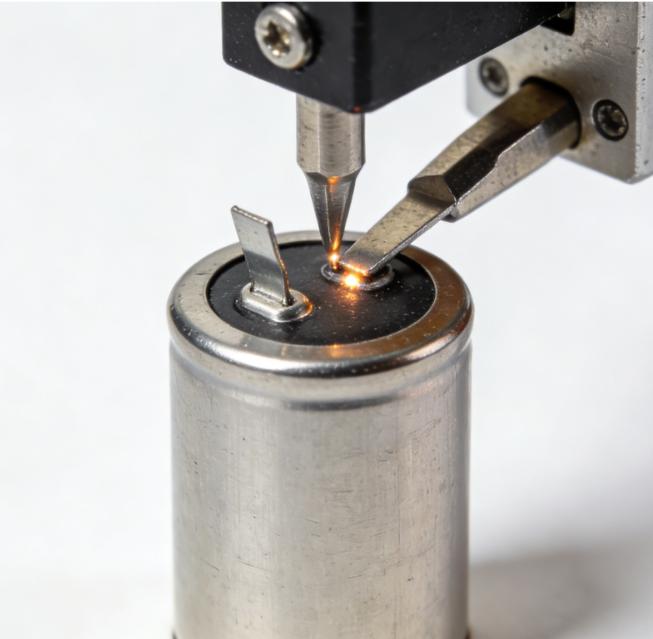
Working Principle
Resistance spot welding is the most widely used technology in cylindrical battery manufacturing, leveraging Joule heating to form metallic bonds. The process involves three core steps:
Clamping: Two copper alloy electrodes apply controlled pressure (typically 10–50 N) to the overlapping tab and substrate (e.g., battery cap or busbar), ensuring intimate contact.
Current Application: A short, high-intensity electrical current (1–10 kA for small cells, up to 50 kA for large-format 4680 cells) passes through the contact point. The resistance between the tab, substrate, and electrode interfaces generates rapid Joule heating (up to 1500–2000°C).
Weld Formation: The localized heat melts the metal surfaces, forming a molten "nugget" that solidifies into a permanent joint as the current is cut off and pressure is maintained for 10–50 ms.
Key parameters—current magnitude, pulse duration, and electrode pressure—are precisely calibrated to avoid overheating (which can damage battery electrolytes or separators) or under-welding (which results in weak joints).
Applications in Cylindrical Batteries
RSW is the go-to choice for high-volume cylindrical battery production due to its speed, low cost, and scalability:
Cell-Level Assembly: Joining nickel-plated steel tabs to the positive cap or negative can of 18650/21700 cells. For example, consumer electronics batteries (18650) use RSW with 2–5 kA current and 20 ms pulses to form small, uniform nuggets (0.5–1 mm diameter) that minimize internal resistance.
Module Assembly: Connecting multiple cylindrical cells into modules via busbars. EV-grade 21700 modules (e.g., Tesla’s Model 3) use automated RSW systems with dual electrodes to weld 10–12 cells simultaneously, achieving a throughput of 100–200 welds per minute.
Low-Cost Production: RSW equipment is affordable (industrial systems start at $10,000) and requires minimal maintenance, making it ideal for small-to-medium manufacturers producing entry-level EV batteries or consumer electronics.
Advantages and Limitations
Pros: High speed (10–50 welds per second), low operational costs, compatibility with most battery tab materials (nickel, copper, nickel-plated steel), and easy integration into automated production lines.
Cons: Limited precision—excessive heat can cause tab deformation or separator damage in high-energy-density cells (e.g., 4680). Copper tabs (with low resistance) require higher currents, increasing energy consumption and electrode wear. Weld quality is sensitive to surface contamination (e.g., oxide layers), requiring pre-cleaning of tabs.
2. Ultrasonic Spot Welding (USW): Precision for Delicate and High-Conductivity Materials

Working Principle
Ultrasonic spot welding uses mechanical vibration rather than electrical resistance to form bonds, making it ideal for heat-sensitive or high-conductivity materials (e.g., thin copper tabs). The principle is as follows:
Clamping: A sonotrode (vibrating electrode) and anvil apply moderate pressure (5–20 N) to the tab-substrate interface.
Ultrasonic Vibration: The sonotrode generates high-frequency vibrations (20–40 kHz), creating frictional heat at the contact surface. This heat breaks down oxide layers and plasticizes the metal (without melting it), enabling atomic diffusion between the tab and substrate.
Bond Formation: The plasticized metal forms a solid-state joint as vibration ceases, with no molten phase—reducing thermal damage to surrounding components.
USW relies on vibration amplitude (10–50 μm), pressure, and duration (100–500 ms) to control bond strength, with no electrical current passing through the battery cell itself.
Applications in Cylindrical Batteries
USW is favored for advanced cylindrical battery designs requiring precision and minimal thermal impact:
Thin Tabs and High-Energy Cells: 4680 large-format cylindrical cells (used in Tesla’s Cybertruck) feature thin copper tabs (0.1–0.2 mm) that are prone to melting with RSW. USW forms strong bonds without damaging the tab or cell casing, ensuring consistent conductivity.
Silicon-Anode Batteries: Silicon-based anodes (with high volume expansion) require delicate tab connections to avoid structural stress. USW’s low heat input preserves the anode’s integrity, extending cycle life.
Lab-Scale R&D: Benchtop USW systems (e.g., Branson Ultrasonics models) are used in battery labs to prototype custom cylindrical cells, as they offer precise control over bond parameters and minimal material waste.
Advantages and Limitations
Pros: No thermal damage (ideal for heat-sensitive cells), compatibility with copper and thin materials, no need for pre-cleaning (vibrations remove oxides), and low energy consumption (10–20x less than RSW).
Cons: Lower throughput (1–5 welds per second) than RSW, higher equipment costs ($20,000–$50,000 for industrial systems), and sensitivity to material thickness (best for tabs <0.3 mm). Not suitable for thick busbars or high-strength joints in heavy-duty modules.
3. Laser Spot Welding (LSW): High-Precision for Next-Gen Cylindrical Batteries
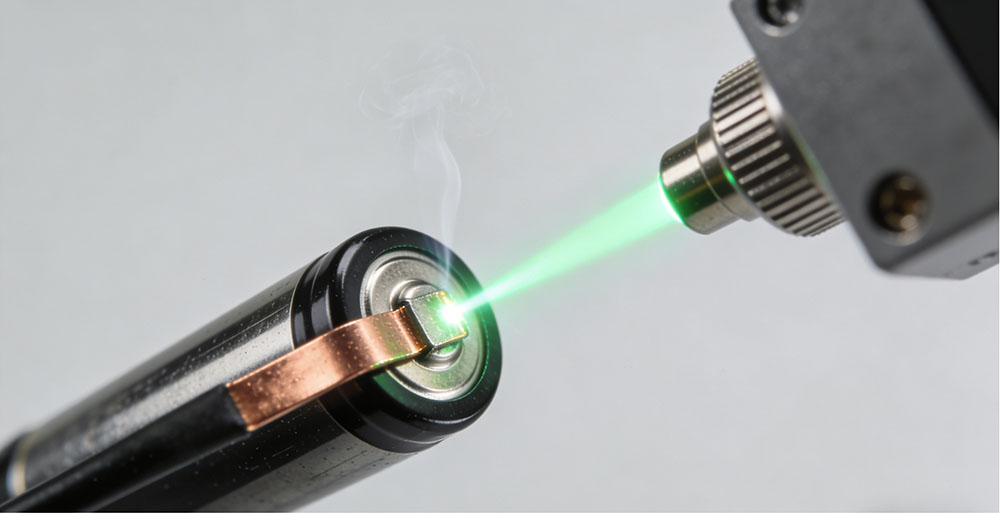
Working Principle
Laser spot welding uses a focused laser beam (typically fiber or Nd:YAG lasers) to deliver concentrated heat, enabling ultra-precise, high-strength welds. The process works as follows:
Beam Focusing: A laser source emits a coherent beam (wavelength 1064 nm for fiber lasers) focused to a small spot (0.1–0.5 mm diameter) on the tab-substrate interface.
Localized Heating: The laser’s energy is absorbed by the metal, rapidly heating and melting a tiny volume (nugget size 0.2–0.8 mm) without affecting surrounding areas.
Weld Solidification: The molten metal cools and solidifies in milliseconds, forming a narrow, deep weld with high mechanical strength and conductivity.
LSW parameters—laser power (100–500 W), pulse duration (1–10 ms), and spot size—are computer-controlled for micron-level precision.
Applications in Cylindrical Batteries
LSW is the technology of choice for high-performance, next-gen cylindrical batteries where precision and reliability are critical:
EV and Energy Storage Modules: Premium EVs (e.g., Porsche Taycan) and grid-scale energy storage systems use LSW to weld cylindrical cell modules, as it ensures consistent weld strength across hundreds of cells, reducing module resistance and improving thermal management.
High-Voltage Batteries: Cylindrical batteries for aerospace or military applications (operating at 400+ V) require defect-free welds to prevent arcing. LSW’s ability to produce narrow, uniform nuggets minimizes this risk.
Custom and Low-Volume Production: Laser systems can be programmed to weld non-standard cylindrical formats (e.g., 32600 cells for solar storage) with minimal tooling changes, making them ideal for specialized manufacturing.
Advantages and Limitations
Pros: Ultra-high precision (spot size down to 0.1 mm), minimal thermal impact (heat-affected zone <0.5 mm), high weld strength (2–3x stronger than RSW for equivalent tab thickness), and compatibility with all tab materials (including refractory metals).
Cons: High upfront costs (industrial fiber laser systems start at $50,000), higher maintenance requirements (laser lenses need regular cleaning), and sensitivity to surface reflectivity (shiny copper tabs may require anti-reflective coatings or adjusted laser parameters).
Key Considerations for Choosing a Spot Welder in Cylindrical Battery Production
Selecting the right spot welding technology depends on four critical factors:
Battery Design: Thin tabs (≤0.2 mm) or heat-sensitive chemistries (e.g., silicon anodes) favor USW or LSW; thick tabs (≥0.3 mm) or high-volume production prioritize RSW.
Manufacturing Scale: RSW is optimal for mass production (100k+ cells/day); LSW and USW suit medium-volume (10k–50k cells/day) or custom production.
Cost Constraints: RSW offers the lowest total cost of ownership; LSW requires a higher initial investment but delivers long-term value for high-performance batteries.
Quality Requirements: EV and aerospace applications demand LSW’s defect-free welds; consumer electronics can rely on RSW’s cost-effective consistency.
Future Trends in Cylindrical Battery Spot Welding
As cylindrical batteries evolve toward larger formats (e.g., 4680) and higher energy densities, spot welding technologies are advancing to meet new challenges:
Automation and AI: Automated RSW/LSW systems with machine vision and AI algorithms now detect tab misalignment or surface defects in real time, adjusting parameters to ensure weld quality.
Hybrid Welding: Combining USW and LSW (e.g., ultrasonic pre-treatment to remove oxides, followed by laser welding) improves bond strength for copper tabs in 4680 cells.
Miniaturization: Lab-scale laser welders are becoming smaller and more affordable, enabling academic and startup researchers to prototype next-gen cylindrical batteries with precision.
Contact: Lika
Phone: +86-19906035385
Tel: 0086-592-7161550
Email: sales@aotbattery.com
Add: No.168, Zhaogang Road, Xiamen City, China
 1173116801
 sales@aotbattery.com