
Home > News
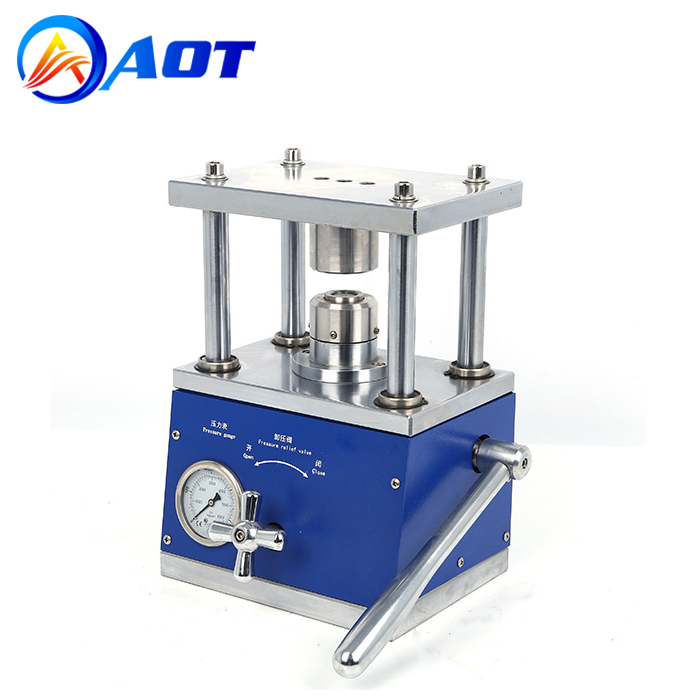
The Coin Cell Crimper is a core equipment developed by the laboratory for small-scale trial production and precise battery packaging. It is mainly used for sealing and opening of standard button batteries such as CR2032, CR2025, and CR2016. It can also be adapted to special models to complete high-precision sealing operations. It directly determines the sealing performance, consistency, and cycle life of the battery, and is an indispensable tool in the material testing, cell trial production, and quality inspection processes. This article, based on real application scenarios, model comparisons, and frequently asked questions from customers, provides directly applicable selection and usage plans to help users precisely match the equipment, reduce failure rates, and improve R&D and production efficiency.
1. Real-world Application Scenarios of Coin Cell Crimper
A high-quality Coin Cell Crimper is not a universal tool but a specialized device that maintains stable accuracy under specific working conditions. Here are some scenarios of high-frequency applications:
(1)In a laboratory glove box where the environment is filled with argon gas and the water-oxygen content is less than 1 ppm, the device operates continuously for 8 hours and still maintains a sealing height error of ≤ ±0.02mm. This prevents leakage and short circuits of the battery cells due to poor sealing, ensuring the authenticity and validity of the test data for solid-state batteries and lithium-metal batteries.
(2)In the material research and development of universities and research institutes, when packaging 200 button cells for single iterations of cathode materials or electrolyte formula tests, the consistency deviation of the sealing force is less than 1%, ensuring that the test data of different batches of battery cells can be compared, reducing experimental errors and repetitive workload.
(3) In small-batch trial production and incoming material inspection in factories, under normal room temperature and continuous operation for 72 hours, the device has no oil leakage or mold jamming, and the good product rate of sealing remains above 99.5%, meeting the requirements for new product prototyping, supplier incoming material inspection, and small-batch delivery.
(4)For precise sealing in medical and consumer electronics, used for micro button cells in hearing aids, smart wearables, and IoT sensors, the sealing edges have no burrs or shell deformation, meeting the safety and appearance standards of medical electronics and consumer electronics, and reducing the rate of after-sales repairs.
(5)After replacing the dedicated molds, it can complete operations such as flattening of electrode sheets, powder pressing, and capacitor sealing. One device covers the entire research process, reducing the investment cost of laboratory equipment.
2. Comparison Analysis of Coin Cell Crimper Models
Before making a purchase, customers will inevitably compare manual, electric, and pneumatic models. Providing objective comparisons actively will help build professional trust more easily.
(1)Manual Coin Cell Crimper
Advantages: Low cost, small size, no need for external power supply / air source, can be placed in a glove box, suitable for small-scale research and teaching demonstrations.
Limitations: Force is affected by manual operation, consistency is average, continuous packaging efficiency is low, and fatigue is prone to occur after long-term use.
Applicable scenarios: Daily average packaging < 50 pieces, limited budget, and high mobility requirements in laboratories.
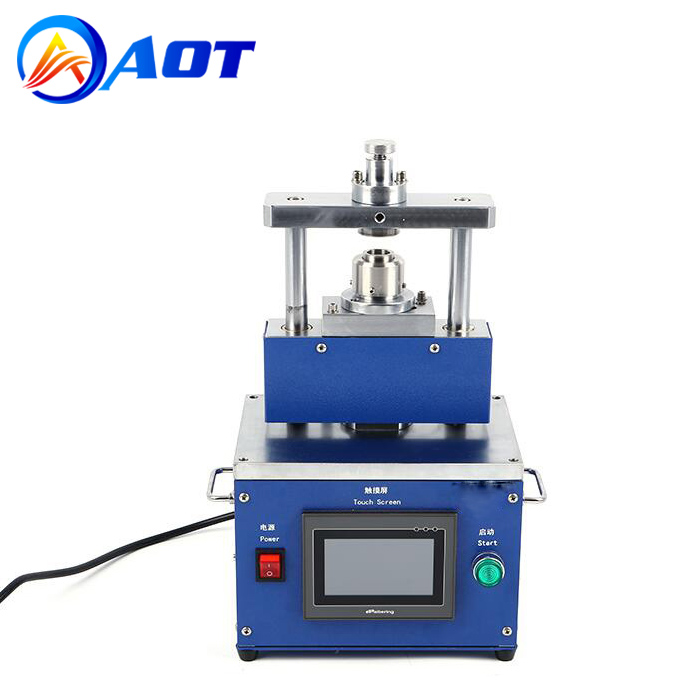
(2)Electric coin cell crimping Machine
Advantages: Digital pressure adjustment, stable force, easy operation, moderate efficiency, compatible with glove boxes and ordinary desktops.
Limitations: Requires power supply, some models are larger than manual models.
Application scenarios: Daily packaging of 50-300 pieces, materials research and battery cell testing that require consistent data.
(3)Pneumatic Coin Cell Crimping Machine
Advantages: Smooth pressure output, high repeatability, maximum efficiency, suitable for continuous batch production, low failure rate.
Limitations: Requires external compressed air supply, some large models cannot be placed in glove boxes.
Application scenarios: Daily packaging of more than 300 pieces, factory trial production, batch detection by quality departments.
Dimension | Manual version | Electric version | Pneumatic version |
Operational efficiency | Low | Medium | High |
Sealing consistency | Generally | High | Extremely |
Glove box compatibility | Easy to adapt | Compatible | Incompatible |
Maintenance difficulty | Low | Medium | Low |
Procurement cost | Low | Medium | Medium-high |
3. Problems and Solutions with Coin Cell Crimper
(1) Which types of batteries can be sealed by the Coin Cell Crimper?
The standard model is compatible with CR2016, CR2025, and CR2032; by replacing the dedicated mold, it can support non-standard models such as CR2325, CR2450, AG3, and AG5. One device can cover the vast majority of commonly used button batteries in laboratories.
(2) Can the equipment be used in a glove box?
The manual and small electric models have a compact body and can be directly placed in a standard glove box; the pneumatic models, due to size and air path limitations, are usually used outside the box. Before purchasing, the size and air path interface scheme can be confirmed.
(3) Why is the sealing accuracy insufficient and the battery prone to leakage?
Common causes: mold wear, improper pressure setting, non-compliant shell thickness, operational concentricity deviation. High-quality equipment uses precision processing molds, combined with adjustable limit structures, to control the leakage rate within 0.5%.
(4) Why is the height of the battery not consistent after sealing?
Main reasons: unstable pressure, unsecured limit, eccentricity of the mold, large tolerance of the battery shell thickness. High-precision equipment with digital pressure display and mechanical limit locking can ensure that the continuous sealing height difference is ≤ ±0.02mm.
(5) Can the equipment perform both sealing and unsealing simultaneously?
Yes, simply replace the corresponding unsealing mold, no need for additional purchase of an unsealing machine, reducing equipment investment and improving laboratory space utilization.
(6) How to determine the quality of the Coin Cell Crimper?
Check three points: mold processing accuracy (surface smoothness, no burrs, high concentricity), pressure stability (no significant fluctuations during continuous operation), and structural durability (body does not deform, no oil leakage, smooth operation).
4. How to Select a Quality Coin Cell Crimping Supplier
Choosing equipment essentially means choosing a supplier. A high-quality supplier typically possesses the following characteristics:
(1)Capable of providing customized solutions: They can recommend models based on glove box size, battery type, and production requirements.
(2)Ensured mold accuracy: Utilizing precise manufacturing processes, they provide mold accuracy inspection data and support sample sealing trials.
(3) Quick response in after-sales service: They offer installation guidance, mold replacement tutorials, and rapid fault detection to minimize downtime losses.
Contact: Lika
Phone: +86-19906035385
Tel: 0086-592-7161550
Email: sales@aotbattery.com
Add: No.168, Zhaogang Road, Xiamen City, China
 1173116801
 sales@aotbattery.com