
Home > News
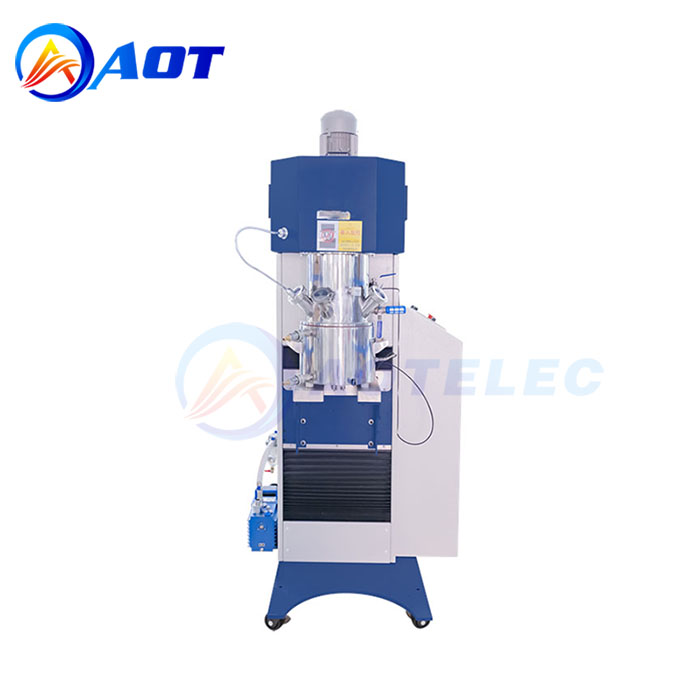
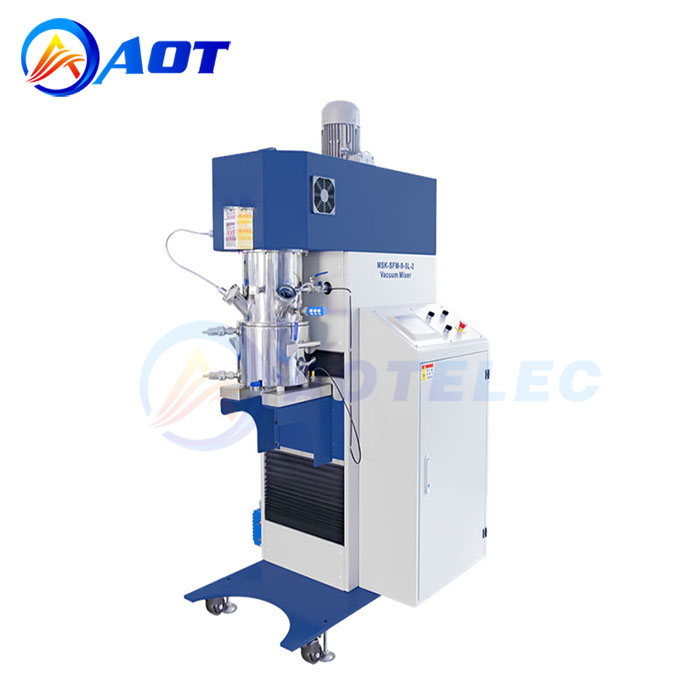
A newly specified four-shaft planetary vacuum mixer, designated MSK-SFM-9-5L, brings a multi-blade configuration and high-vacuum operation to the 5-liter scale, aiming at dispersion and homogenization challenges in lithium-ion battery and advanced ceramic slurry preparation.
Four-shaft architecture for simultaneous macro- and micro-mixing
The MSK-SFM-9-5L employs a four-shaft planetary arrangement: two low-speed stirring blades, two high-speed dispersing blades, and one wall-scraping spatula operating within a single 5-liter working volume. This combination is designed to address a common trade-off in slurry mixing—low-speed blades handle bulk kneading and circulation, while high-speed dispersing discs generate localized shear to break down agglomerates and wet powders into binders or solvents. The planetary motion, in which the blade assembly rotates both around the vessel axis and on its own axis, continuously renews shear zones throughout the tank rather than relying on a fixed mixing path.
The stirring blades operate at 2–112 rpm, with a suggested lower limit of 5 rpm for gentle homogenization, while the dispersing blades reach up to 6,900 rpm, with the caveat that continuous operation at 6,000–6,900 rpm should be limited to 30 minutes. This separated speed regime allows the operator to decouple bulk blending from high-shear dispersion within the same batch.
Vacuum integration for bubble suppression and slurry stability
The mixing tank operates at a vacuum level of −0.098 MPa, which is intended to remove entrained air and micro-bubbles from the slurry during processing. In conventional high-speed mixing of viscous slurries containing active materials, binders, and conductive carbon black, air is readily trapped, and residual bubbles can translate into coating defects and variability in electrochemical performance. By maintaining vacuum throughout the mixing cycle, the MSK-SFM-9-5L targets a denser, more homogeneous slurry before coating or casting.
The tank itself is constructed from SUS304 stainless steel, with a total volume of approximately 8 liters and a maximum effective mixing capacity of 5 liters. An observation window on the mixing tank allows visual monitoring of the mixing state without breaking vacuum. The stated maximum slurry viscosity is 100,000 mPa·s (cps), covering the range typically encountered in electrode slurries and ceramic pastes.
Control and process reproducibility
A PLC touch-panel interface manages the mixing parameters, supporting multi-stage speed and time programming. This is particularly relevant for slurry formulations where a low-speed kneading phase precedes high-shear dispersion, followed by a final vacuum degassing step under reduced agitation. The ability to store and repeat multi-step profiles reduces operator-dependent variability and supports scale-up studies from laboratory batches toward pilot or production volumes.
Application focus: battery and ceramic slurries
The MSK-SFM-9-5L is specified as a tool for preparing LiCoO₃, LiFePO₄, LiNCMO₂, and ceramic slurries, where both dispersion quality and the absence of entrained gas directly influence the uniformity of the final electrode or ceramic layer. The 5-liter effective capacity places the instrument in a bench-to-pilot transition zone—large enough to generate representative mixing data but compact enough for formulation screening and process development.
With its four-shaft planetary motion, high-vacuum degassing capability, and programmable multi-stage control, the MSK-SFM-9-5L addresses the intersection of dispersion intensity and slurry integrity that defines performance in particulate-based coating processes. The system carries CE certification, with NRTL or CSA certification available on request.
Contact: Lika
Phone: +86-19906035385
Tel: 0086-592-7161550
Email: sales@aotbattery.com
Add: No.168, Zhaogang Road, Xiamen City, China
 1173116801
 sales@aotbattery.com