
Home > News
A split test cell designed for simple and rapid assembly testing of rechargeable battery electrode materials is drawing attention for its ability to support in-situ X-ray diffraction analysis during charge and discharge cycling. The detachable cell, identified as model AOT-EQ-STC-BEW, incorporates a beryllium observation window that allows the X-ray beam to penetrate the cell and probe the electrode material directly.
The central feature of the design is a 35 mm diameter beryllium window with a thickness of 0.15 mm. Because beryllium is relatively transparent to X-rays, the window enables researchers to monitor phase transitions in battery materials as they occur during cycling, rather than relying only on ex-situ measurements. For PTFE sleeves with inner diameters of 20 mm and 24 mm, the cell supports an XRD diffraction angle (2θ) range of 5° to 170°, covering a broad range of diffraction experiments.
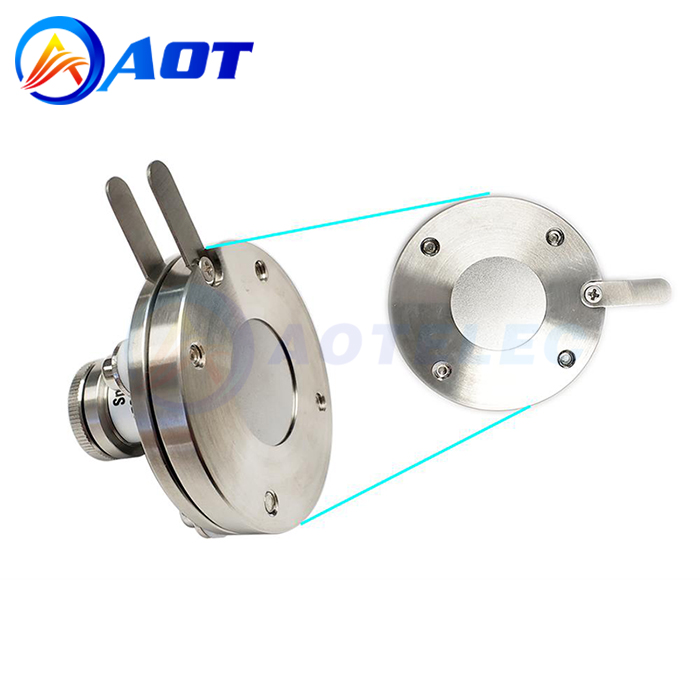
The cell is compatible with electrodes and separators of various sizes, including diameters of 19 mm, 20 mm, and 24 mm. Its PTFE guide sleeve is available with matching inner diameters of 19 mm, 20 mm, and 24 mm, while the outer diameter is 29 mm. The sleeve surrounds a stainless steel pressing pad. The maximum cell thickness for the cathode, separator, and anode combined is 5 mm, and the cell can operate at temperatures up to 250°C.
Construction materials are selected for durability and chemical resistance. The cell body and pressing plate are made of stainless steel, and the assembly includes a beryllium window, PTFE sleeve, PTFE O-rings, and stainless steel hex screws. The PTFE guide sleeve is designed to resist electrolyte corrosion and can withstand temperatures up to 250°C, while the PTFE O-rings provide sealing against electrolyte exposure.
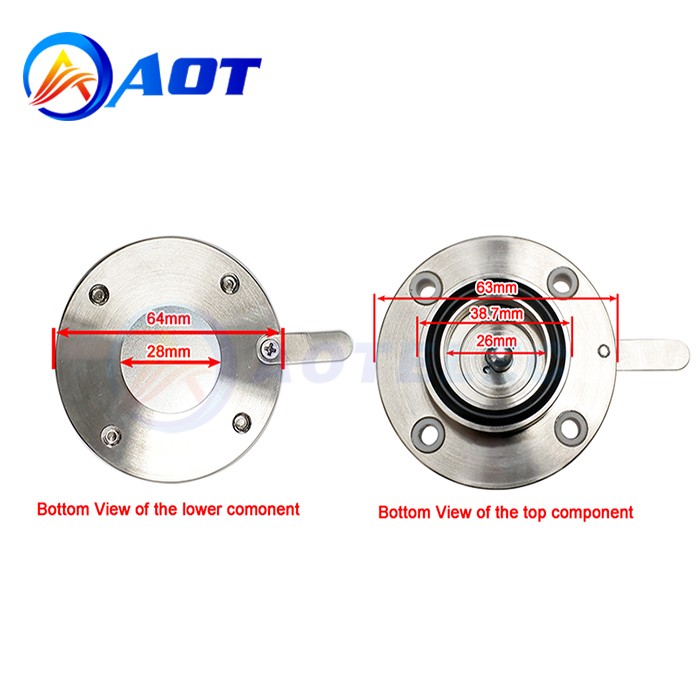
The cell’s slim profile is intended to allow operation inside a glove box. Its dimensions include a minimum height of 47 mm without load, a widest diameter of 64 mm without lead, and a lead-exposed length of 12.6 mm. The split structure is designed to make assembly, separation, and cleaning straightforward after each experiment, supporting repeated use in laboratory settings.
Functionally, the split test cell offers capabilities similar to a Swagelok coin cell but provides more size options for electrodes. By combining a detachable configuration with a beryllium observation window, the cell is positioned as a practical tool for battery materials research, particularly for studies that require direct structural observation during electrochemical cycling. The design aims to simplify sample assembly and handling while enabling in-situ XRD analysis of phase changes in rechargeable battery electrode materials
Contact: Lika
Phone: +86-19906035385
Tel: 0086-592-7161550
Email: sales@aotbattery.com
Add: No.168, Zhaogang Road, Xiamen City, China
 1173116801
 sales@aotbattery.com