
Home > News
Lithium coin cells, represented by the widely adopted CR2032 model, serve as the core power source for wearable electronics, medical sensors, smart cards, IoT devices, and laboratory electrochemical research. For battery research laboratories and small-batch pilot production lines, consistent, repeatable cell assembly is the foundation of reliable electrochemical test data. Traditional single-station coin cell assembly equipment only processes 8 cells per batch at maximum, which creates a severe throughput bottleneck when researchers screen dozens of electrode materials, electrolyte formulas, or separator combinations simultaneously. Manual assembly further introduces human errors, inconsistent stacking concentricity, uneven electrolyte dosing, and unstable sealing pressure, leading to scattered test results and low experimental reproducibility.
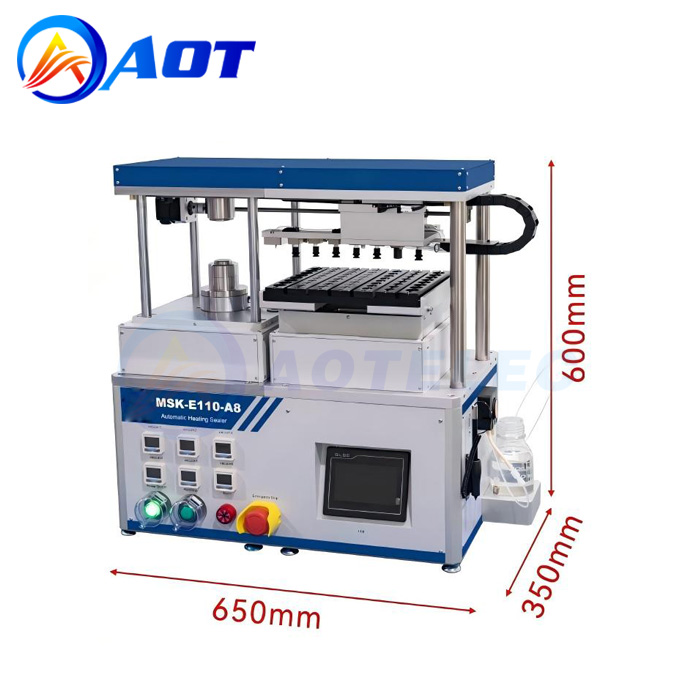
The 16-Channel Automatic Coin Cell Assembling Machine (Model AOT-MSK110-A16) is developed to resolve these pain points. This bench-top high-throughput automation system is purpose-built for CR2032 coin cell assembly, supporting full-process automatic stacking, precision electrolyte injection, and servo-driven crimp sealing in inert environments such as argon-filled glove boxes and low-humidity dry rooms. By expanding batch capacity to 16 cells in one single loading cycle, the equipment drastically boosts laboratory R&D efficiency while standardizing every assembly parameter to eliminate manual interference. This article systematically elaborates on its core design, full workflow, technical advantages, key specifications, application scenarios, and value for lithium battery research and small-scale manufacturing, with a total word count of approximately 1,000.
1. Core Design & Structural Composition
The machine adopts an integrated compact bench-top framework tailored for glove box installation, avoiding oversized footprints that occupy limited inert workspace. Its main structure is divided into five functional modules: material feeding tray unit, multi-channel automatic stacking manipulator, precision electrolyte filling system, servo closed-loop sealing station, and touchscreen intelligent control system. A built-in vacuum pump and micro-positive pressure auxiliary suction mechanism are integrated as standard configurations to optimize sheet handling inside water-oxygen-controlled environments.
1.1 Multi-Tray Feeding Module
Two standard high-precision material trays are supplied, each preloading complete CR2032 raw components including positive shells, spring shims, flat gaskets, cathode sheets, separators, lithium metal anodes, and negative cans. Tray positioning accuracy reaches ±0.05 mm, locking component positions firmly to prevent offset during automatic grabbing.
1.2 Automatic Stacking Manipulator with Micro Positive Pressure
The servo-driven suction manipulator handles separators, cathode, and lithium anode sheets via micro-positive pressure auxiliary blanking, which prevents thin separator film wrinkling or electrode sheet deformation during pickup.
1.3 Precision Electrolyte Injection System
A single high-precision peristaltic pump serves as the standard filling unit, with a minimum adjustable injection volume of 0.01 g. The recommended electrolyte dosage for CR2032 cells is 75 mg, and the injection error is controlled within ±7 mg (±7% relative error). For electrolyte volumes below 0.1 g, the machine maintains the same ±7 mg tolerance to guarantee consistent liquid addition across all 16 channels.
1.4 Servo Closed-Loop Sealing Station
Sealing quality directly determines CR2032 cell leakage resistance and cycle stability. The machine uses servo motor closed-loop pressure control, with adjustable crimping pressure ranging from 500 kg to 700 kg (industry standard for CR20 series coin cells) and a maximum pressure ceiling of 1000 kg.
1.5 Touchscreen Central Control System
A human-machine touchscreen interface integrates all parameter settings, real-time running status display, and fault alarm prompts. Operators can save multiple assembly recipes for different electrode materials or electrolyte formulations, enabling one-click recall to avoid repeated parameter input.
2. Full Automatic Assembly Workflow for CR2032 Cells
The entire assembly cycle runs automatically after one-time material loading, following a streamlined four-step process optimized for glove box operation:
The machine completes the full assembly batch of 16 cells within 30 minutes, delivering a throughput far higher than single-station 8-cell equipment. After cycle completion, the equipment sends a reminder alarm, and operators only retrieve finished cells to start the next batch.
3. Key Technical Specifications Overview
The machine operates on single-phase AC110–220 V (±10%), 50/60 Hz power supply with total power consumption of 200 W. Its main body dimensions are compact for glove box placement, with total machine weight controlled below 80 kg for easy glove box internal layout adjustment. Material tray positioning precision hits ±0.05 mm, stacking coaxiality ≤ ±0.1 mm, and sealing pressure adjustable within 500–1000 kg with 0.5% FS sensor accuracy. Standard delivery includes the 16-channel assembly main unit, CR2032 crimping die, two material trays, built-in vacuum pump, complete spare parts kit, and full operation manuals.
4. Application Scenarios
The 16-Channel CR2032 Automatic Coin Cell Assembling Machine targets three primary user groups. First, university and research institute lithium battery laboratories conducting cathode, anode, electrolyte, and separator material screening, where high batch consistency and throughput are essential for comparative electrochemical testing. Second, new energy material enterprises’ pilot R&D workshops developing solid-state lithium metal coin cells, which demand strict inert environment compatibility and precise sealing to prevent lithium oxidation. Third, small-scale manufacturers producing CR2032 batteries for smart wearables and medical devices, replacing low-efficiency semi-automatic equipment to stabilize small-batch product quality.
Against the backdrop of booming lithium battery material research, the demand for high-throughput, high-consistency automatic coin cell assembly equipment continues to rise. By standardizing every assembly step from component stacking to electrolyte injection and crimp sealing, it delivers stable, reproducible CR2032 coin cells for electrochemical testing and small-batch production. For academic researchers and new energy developers, this 16-channel system represents a cost-effective, high-efficiency upgrade path that accelerates material innovation while lowering experimental error and labor costs, becoming an indispensable core automation tool in modern coin cell R&D laboratories.
Contact: Lika
Phone: +86-19906035385
Tel: 0086-592-7161550
Email: sales@aotbattery.com
Add: No.168, Zhaogang Road, Xiamen City, China
 1173116801
 sales@aotbattery.com