
Home > News
1. What is a battery roll press machine?
(1) What is a battery roll press machine: The battery roll press machine is a precision roll press equipment specifically used in lithium battery production. It belongs to the core non-standard automated equipment in the pre-processing and mid-processing stages of lithium battery preparation - electrode sheet forming process. The equipment relies on a pair of high-precision parallel rolls, applying controlled pressure through mechanical/hydraulic means, combined with a cold/hot temperature control system, to compress and shape the positive and negative electrode roll sheets of lithium batteries that have been coated and dried. Unlike ordinary flat press machines, it supports continuous roll-to-roll automated roll pressing and is specifically designed for the production of thin and porous electrode materials for lithium batteries.
(2) The main functions of the battery roll press machine: First, it compresses the surface active coating of the electrode sheet, eliminating the pores in the electrode sheet after coating, significantly increasing the compression density of the electrode sheet and directly enhancing the energy density of the lithium battery cell; second, it uniformly controls the thickness tolerance of the entire electrode sheet across the roll, eliminating the thickness errors during coating, ensuring the consistency of capacity and internal resistance parameters of the same batch of cells; third, it strengthens the bonding force between the electrode coating and the copper foil and Aluminum Foil current collector, preventing the detachment and powdering of the coating in subsequent processes such as cell winding and liquid injection; fourth, it optimizes the internal structure of the electrode material through the thermal roll pressing process, improving the stability of battery charge and discharge cycles; fifth, it standardizes the thickness size of the electrode sheet, adapting to the subsequent cutting, winding, and assembly equipment connections, thereby increasing the yield rate of the entire lithium battery production line.
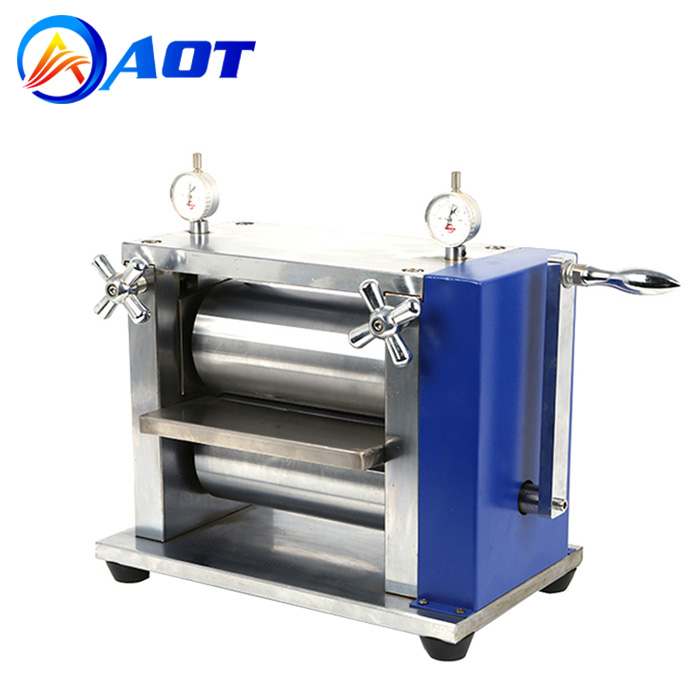
(3) In simple terms: The battery roll press machine is the key equipment for controlling the performance upper limit of lithium-ion battery cells. If the foil roll pressing process does not meet the standards, even the most excellent subsequent battery cell assembly process cannot make up for the shortcomings in battery endurance and cycle life.
The battery roll press machine (also commonly known as the battery calendering machine) is the core processing equipment in lithium-ion battery production after the coating process. The equipment is mainly used to compact the positive and negative electrode foils after coating, unify the thickness specifications of the foils, and increase the energy density of the battery cells. Unlike ordinary industrial compaction equipment, this precision equipment can maintain extremely high operational stability under high-load continuous production conditions. It is indispensable as a dedicated lithium battery equipment from laboratory battery research to the mass production line of new energy vehicle battery cells.
2. Core application scenarios
A qualified industrial-grade battery roll press machine, its core advantage is not the nominal parameters marked on the paper, but the operational precision and stability in complex actual production scenarios. Here are the three main mainstream application scenarios of the equipment, along with real workshop operation measurement data:
Scenario 1: Mass production line of vehicle battery cells. Conduct 24-hour uninterrupted continuous roll pressing operations in a workshop with a constant temperature of 35°C and an environmental humidity of 60%. Our hydraulic battery roll press machine can maintain a stable tolerance of ±1 μm for the thickness of high-nickel ternary positive electrode foils. After continuous 72-hour non-stop roll pressing operation of the equipment, the gap deviation of the rolls does not exceed 0.003 mm, and the battery cell foils can be pressed to a standard compact density of 3.6 g/cm³. It can prevent batch production defects such as bulging of vehicle battery module cells and inconsistent single cell capacity caused by uneven thickness of the foil from the source.
Scenario 2: Pilot production line for small consumer batteries. For assembly lines of 18650 and 21700 cylindrical batteries, the semi-automatic battery rolling press can be adapted to meet the frequent production changeover requirements. It can batch process negative electrode current sheets of 100-300mm width made of lithium iron phosphate, and no defective products such as edge cracking or coating detachment will occur regardless of whether it is during the low-speed equipment debugging stage or the formal mass production.
Scene 3: Research and Development of New battery materials in the Laboratory. The desktop precision roll press can operate normally in an inert gas environment of a glove box, supporting customized cold and hot roll pressing processes for new electrode materials of solid-state batteries; it helps research institutions complete the pressing of small batches of samples, and throughout the process, the fragile experimental active coating will not be damaged.
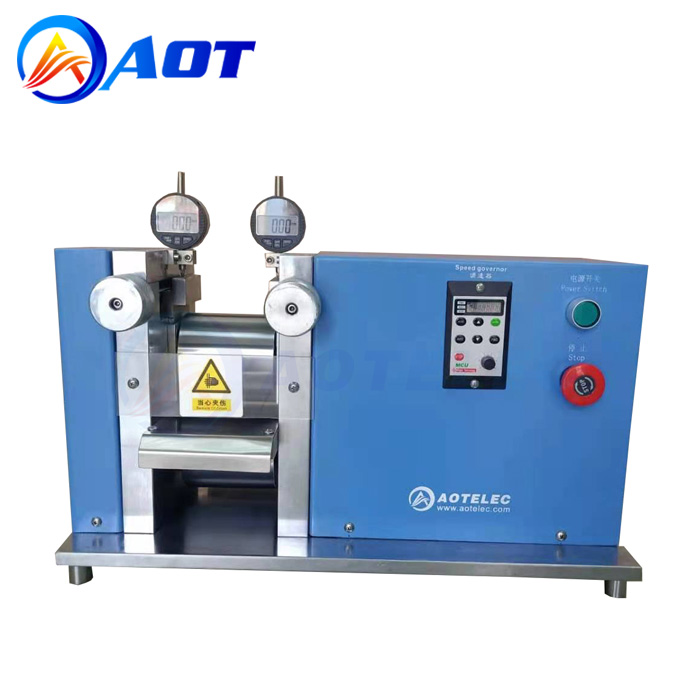
3. Comparison of Battery Roll Presses
(1) Roll Material and Hardness: The high-quality industrial-grade equipment uses tungsten carbide-coated rolls, with a Rockwell hardness of HRC 62, having excellent scratch resistance, and will not deform even under long-term load operation; while the low-priced ordinary model uses ordinary 45# steel rolls, with a Rockwell hardness of only HRC 45, and will easily undergo elastic deformation after continuous operation for 100 hours.
(2) Operating accuracy: Under long-term mass production operation, the thickness tolerance of high-quality industrial-grade battery roll press machines can be stably maintained within ±0.5 to ±1 μm; for the low-priced ordinary model, the static detection tolerance is ±3 μm, but after continuous production, the accuracy will drift to ±8 μm.
(3) Adaptable processing materials: High-quality equipment can be compatible with all types of lithium battery materials, including high-nickel ternary, lithium iron phosphate, lithium titanate, and solid-state battery electrodes; while the low-priced models can only be compatible with conventional low-density lithium iron phosphate ordinary electrode sheets.
4. Common Issues
Q1: Why do the battery electrode sheets after rolling have wrinkles and edge cracking? A: More than 90% of such faults result from unqualified parallelism of the rollers and imbalanced roller pressing speed matching. The synchronous control system of the low-end equipment's rollers has poor accuracy; moreover, the temperature of the hot rollers does not match the formula of high-nickel electrode materials, which can also cause the active coating to fall off. The high-quality rolling machine is equipped with a dual servo synchronous control system, which can solve these production defects from the root cause.
Q2: What are the differences between cold roller pressing and hot roller pressing for battery electrode sheets? A: Cold roller pressing is suitable for regular lithium iron phosphate negative electrode sheets with lower compression ratio requirements; the hot roller pressing with adjustable temperature ranging from 50 to 120 degrees Celsius is a necessary process for processing high-nickel ternary positive electrode sheets, which can enhance the ductility of the electrode material and meet the production standards for high-density and high-pressure.
Q3: Can the equipment be customized for the width? Can it be adapted to non-standard production lines? A: Yes. Regular manufacturers support OEM customization of the processing width for 50mm - 800mm blister sheets. It can be matched with glove box equipment, small-scale pilot production lines, and fully automatic large-scale mass production lines.
Q4: How long is the normal service life of the standard battery roll press? A: The lifespan of the core roll components is 8 to 10 years; under regular maintenance conditions, the overall machine can operate for 5 to 7 years. The easily damaged parts of the equipment only require simple lubrication and precision calibration on a quarterly basis to ensure stable operation.
Contact: Lika
Phone: +86-19906035385
Tel: 0086-592-7161550
Email: sales@aotbattery.com
Add: No.168, Zhaogang Road, Xiamen City, China
 1173116801
 sales@aotbattery.com