
Home > News
Product Overview
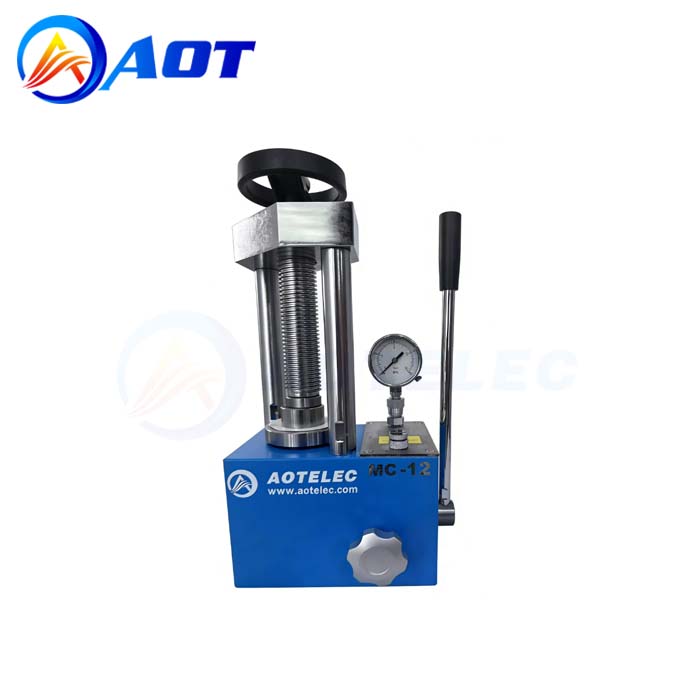
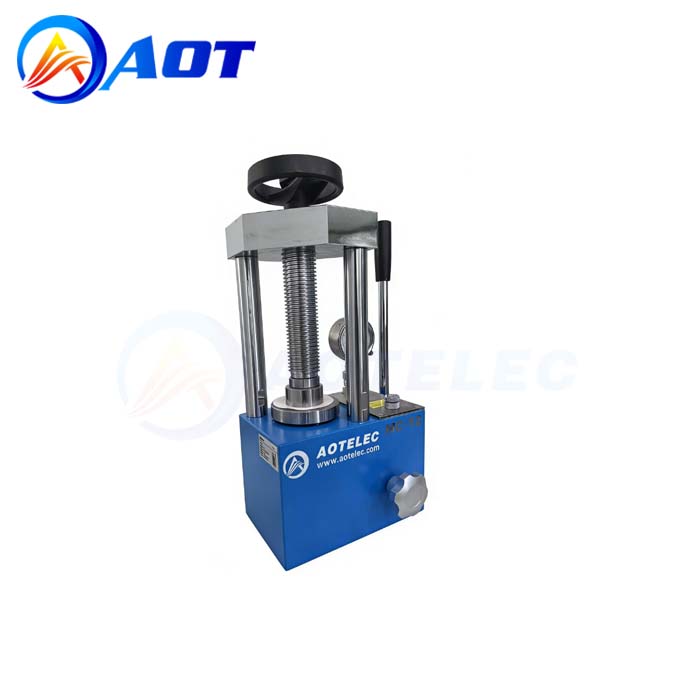
The 12T Manual Hydraulic Press Machine is a benchtop manual hydraulic device designed for powder processing in laboratory R&D and production enterprises. Based on the mechanical lever principle, it can be equipped with molds of various sizes, offering both practicality and operational convenience.
Key Specifications
Model: AOT-MC-12
Pressure Range: 0–12 tons (0–30 MPa)
Working Piston Diameter: 70 mm
Max Piston Stroke: 30 mm
Working Space (Width × Height): 80 × 130 mm
Pressure Stability: ≤1 MPa / 10 minutes
Number of Columns: 2
Weight: 28 kg
Dimensions (Length × Width × Height): 230 × 160 × 420 mm
Structural & Functional Features
Materials & Finish: The main body is made of 304 stainless steel; the housing uses an environmentally friendly spray-coated finish.
Pressure Display: Equipped with a dual-scale pressure gauge that shows both pressure (in tons) and hydraulic pressure (in MPa) directly.
Integrated Design: Seamless construction with no sealing joints, reducing the risk of oil leakage.
Application Scope
This press is an essential tool for compressing powder materials into pellets or sheets in laboratory R&D and production facilities.
Core Applications in battery materials R&D
In battery research, this press is primarily used to compress mixed powders—including cathode/anode active materials, conductive agents, and binders—into dense electrode sheets or pellets. This is a critical step in developing high-performance batteries such as lithium-ion, solid-state, and sodium-ion batteries.
Key roles include:
Improving Energy Density: High-pressure compaction significantly reduces void spaces between powder particles, allowing more active material to be packed into a given volume, thereby increasing energy density.
Establishing Ion Transport Pathways: Compaction creates tight, continuous physical contact between solid electrolyte and electrode particles, providing smooth pathways for ion conduction—especially essential for solid-state battery operation.
Reducing Interfacial Resistance: Intimate particle contact lowers the interfacial resistance between different materials, enabling more efficient energy conversion within the cell.
Fabricating Multilayer Structures: The press can be used to layer and compress different electrode and electrolyte layers into integrated battery units, such as bilayer or multilayer pellets.
Operational & Selection Tips
To achieve optimal experimental results, consider the following points:
1. Select Appropriate Pressure – Different battery material systems require different compaction pressures. For example, some sulfide solid electrolytes may need 370–400 MPa to reach optimal performance. This 12T press can provide up to 12 tons; users must calculate the actual applied pressure in MPa based on the sample area to ensure it meets experimental requirements.
Quick Pressure Estimation*: Actual pressure (MPa) ≈ Force (tons) × 98.1 / Sample area (cm²). For instance, applying 12 tons on a 1 cm diameter pellet generates much higher pressure than on a 3 cm diameter pellet.
2. Ensure Uniform Pressure Distribution – Uniform compaction is critical. Non-uniform density can cause uneven current distribution within the battery, compromising the reliability of experimental data.
3. Use Compatible Dies – By exchanging dies of different sizes and shapes, the press can produce various sample forms such as pellets, sheets, or rods to suit different analytical tests like XRF or SEM, or for battery assembly procedures.
Contact: Lika
Phone: +86-19906035385
Tel: 0086-592-7161550
Email: sales@aotbattery.com
Add: No.168, Zhaogang Road, Xiamen City, China
 1173116801
 sales@aotbattery.com