
Home > News
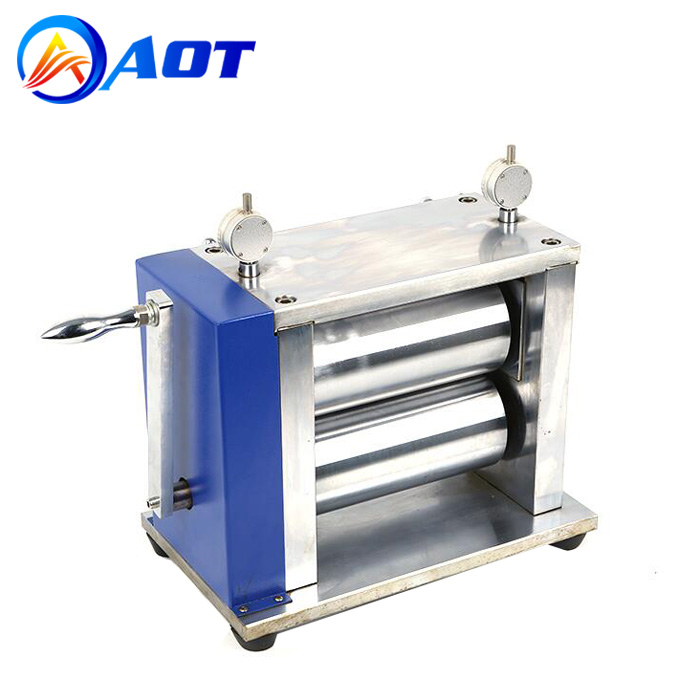
This product is the AOT-MRP-100 manual laboratory roller press, mainly used in the research and development process of lithium batteries to roll electrode sheets, adjust their thickness, and increase the density of active materials.
Core functions and purposes
This is a manually operated desktop device designed specifically for small batch processing in laboratories. In addition to lithium battery electrodes, it can also be used to press precious metals such as gold and silver, as well as non-ferrous metal materials such as copper and aluminum.
Main features and design
Sturdy structure: Made of heavy-duty steel frame, gears, and handles, the rollers are made of hardened tool steel (HRC>60), coated with hard chrome on the surface, durable, and have a good surface finish (>0.8).
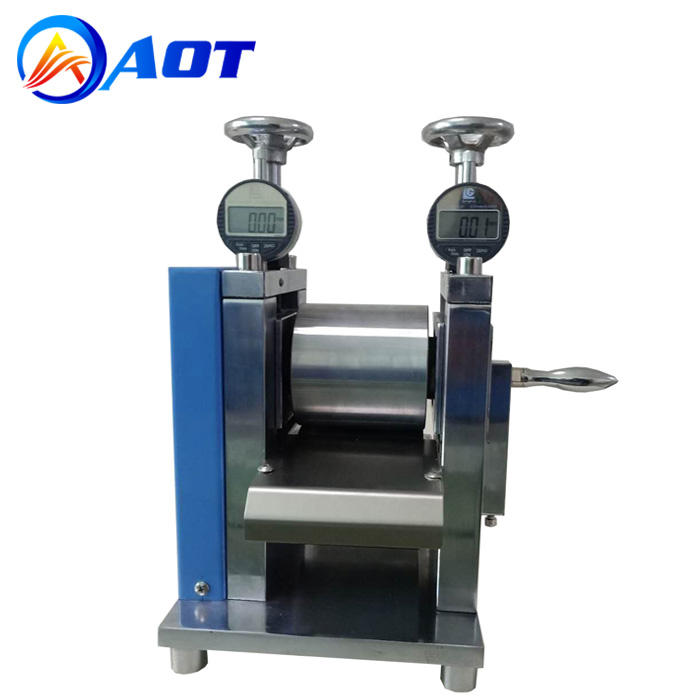
Accurate adjustment: Equipped with dual micrometers for thickness adjustment, it can achieve high-precision control.
Safety design: equipped with transparent protective plates to ensure safe operation.
Applicability: Designed specifically for battery research and development, it combines economy, compactness, and precision.
Important usage precautions
The product description specifically emphasizes the following maintenance points:
Cleaning and rust prevention: After each use, the roller surface must be cleaned and dried with acetone to prevent rusting.
Long term storage: If not used for a long time, rust proof oil should be applied.
Material influence: The minimum thickness that can be rolled depends on the physical properties of the material itself.
Precision adjustment and calibration mechanism
Double micrometer design: independently adjustable left and right, can compensate for the pressure difference at both ends of the roller, avoiding the squeezing of "wedge-shaped" pole pieces (thick on one side and thin on the other). When adjusting, it is necessary to ensure that the readings of the two micrometers are the same.
Accuracy ± 0.005mm: This is the mechanical indication accuracy, and the actual rolling thickness may have slight deviations due to the influence of material elasticity and roller deflection. For laboratory research and development, this accuracy is sufficient.
Calibration method: Use a standard feeler gauge or a metal foil of known thickness, and place it in the roller gap to feel the resistance. When the feeler gauge can just be pulled out and there is a slight friction sensation, read the micrometer value and compare it with the nominal value of the feeler gauge. If there is any deviation, it needs to be recalibrated.
Detailed operation steps
Pre startup inspection: Confirm that the roller surface is clean, free of scratches or residue. Check if the two micrometers have reset to zero and the readings are consistent.
Set thickness: Loosen the locking nut, rotate the micrometer knob, and adjust the roller gap slightly larger than the target thickness (for example, if the target is 0.2mm, it can be set to 0.22mm first). Because the material has elastic recovery.
Pressure testing and adjustment: Take a small piece of waste material for pressure testing, and measure the actual thickness after compression with a spiral micrometer. Adjust the micrometer according to the deviation until the thickness meets the standard.
Formal rolling: Insert the electrode sheet horizontally into the inlet of the two rollers and rotate the handle steadily and uniformly. Too fast speed may result in uneven thickness, while too slow speed can be laborious. Thicker pole pieces can be rolled multiple times with small pressing amounts (such as 0.5mm → 0.3mm → 0.2mm).
Final cleaning: After each use, use a dust-free cloth dipped in acetone to wipe the roller surface and remove residual electrode material. After the acetone has completely evaporated, a thin layer of rust proof oil can be applied (if not used for a long time).
Contact: Lika
Phone: +86-19906035385
Tel: 0086-592-7161550
Email: sales@aotbattery.com
Add: No.168, Zhaogang Road, Xiamen City, China
 1173116801
 sales@aotbattery.com