
Home > News
In the rapidly evolving world of lithium-ion batteries, from powering electric vehicles (EVs) to enabling the latest drones and consumer electronics, the magic often lies in the chemistry of the cathode and anode. However, without a crucial component known as the current collector, all that advanced chemistry would be useless. For the anode (negative electrode), this current collector is Copper Metal Foil.
This blog post dives into the importance of this unsung hero, specifically focusing on the industry-preferred specifications: 9μm (microns) in thickness and 200mm in width. We will explore why these dimensions have become a standard for researchers and manufacturers alike.
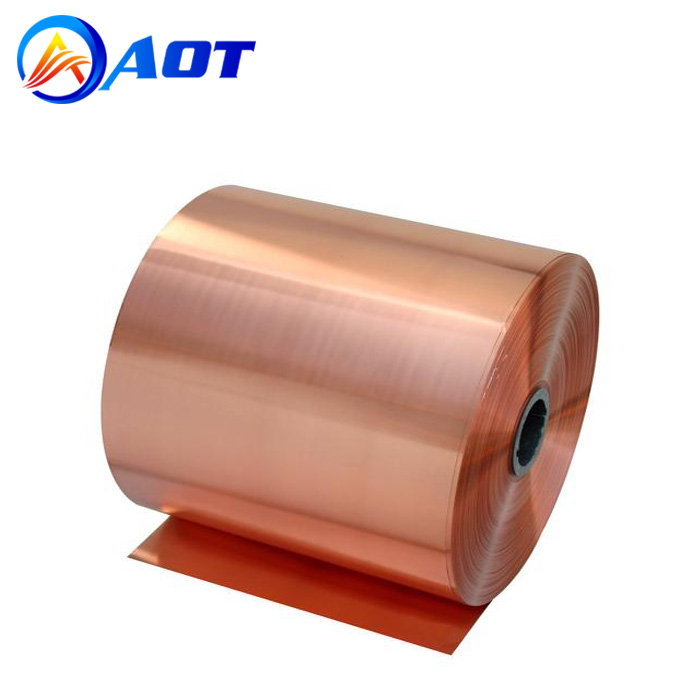
The Critical Role of Copper Foil in Batteries
Copper foil serves two primary functions in a lithium-ion battery cell:
Current Collection: It acts as the substrate onto which the anode active material (like graphite or silicon) is coated. During discharge, it collects the electrons released from the anode and conducts them to the external circuit, powering your device.
Mechanical Support: It provides a flexible yet strong physical backbone for the brittle anode coating, ensuring the electrode maintains its structural integrity during the cell winding and stacking processes, as well as throughout the battery's charge/discharge cycles.
Without high-quality copper foil, even the most advanced anode materials cannot deliver their full potential in terms of power, efficiency, and lifespan.
The Sweet Spot: Why 9μm Thickness and 200mm Width?
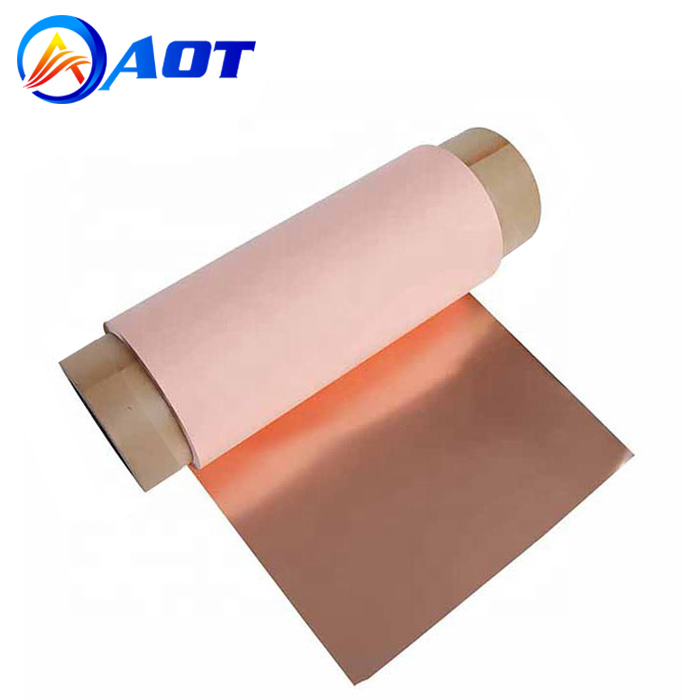
While copper foils come in various dimensions, the 9μm (thickness) x 200mm (width) specification has emerged as a sweet spot for a significant portion of the battery R&D and production landscape.
1. The Drive for Thinness: 9μm
The thickness of the copper foil is a critical lever for battery performance.
Energy Density: The thinner the foil, the less space it takes up inside the cell. This allows manufacturers to pack more active material into the same volume, directly increasing the battery's energy density (Wh/L and Wh/kg). The industry has progressively moved from 12μm to 9μm and is now pushing towards even thinner foils.
Power Density: Thinner foils also offer a shorter pathway for electron transport, which can contribute to improved power delivery.
The Challenge: However, producing 9μm foil is technically challenging. It requires precise control over the rolling or electrodeposition process to ensure the foil is free of pinholes and has consistent mechanical strength. High-quality 9μm foil, such as that which meets a tensile strength of ≥294 MPa, is essential to prevent breakage during battery manufacturing.
2. The Standardized Width: 200mm
While "200mm" might seem like a simple measurement, it represents a key standard in the battery prototyping and pilot production line.
Compatibility: 200mm wide foil rolls are designed to fit seamlessly into common slot-die coating machines and electrode slitting equipment used in R&D labs and pilot lines.
Scalability: Using this width allows researchers and manufacturers to easily translate their coating formulations and processes from small-scale lab experiments to larger pilot production, as the equipment form factors remain consistent.
Application: A 200mm width is ideal for producing electrodes for various cell formats, including pouch cells and prismatic cells.
Key Performance Parameters to Look For
When sourcing 9μm x 200mm copper foil for battery applications, the thickness and width are just the starting point.
Parameter | Typical Specification for 9μm Foil | Why It Matters |
Purity | ≥ 99.9% (Cu) | High purity ensures optimal electrical conductivity and prevents internal side reactions that degrade battery life. |
Areal Density | 85-90 g/m² | Consistency in mass per unit area is critical for uniform anode coating and accurate final cell capacity calculations. |
Tensile Strength | ≥ 294 MPa | High strength prevents the foil from tearing or deforming under the tension of high-speed coating and winding processes. |
Elongation | ≥ 2.5% | Good flexibility allows the foil to withstand the expansion and contraction (breathing) of the anode during charge/discharge cycles without cracking. |
Surface Roughness (Rz) | Matte side: ≤ 3.0 µm / Drum side: ≤ 0.3 µm | A specific surface profile ensures strong adhesion of the anode slurry. Too smooth, and the coating may peel; too rough, and coating uniformity suffers. |
Surface Tension | ≥ 62 dyne/cm | High surface tension (wettability) ensures the liquid anode slurry spreads evenly across the foil without beading up, guaranteeing a uniform coating. |
Future Trends: Where is Copper Foil Technology Heading?
The humble copper foil is undergoing a technological revolution to meet the demands of next-generation batteries.
Thinner Foils: The industry is actively working on mass-producing 6μm and even 4.5μm foils to push energy densities even higher.
High-Strength Foils (e.g., HiSTEP): Companies like LOTTE Energy Materials are developing foils that maintain high strength and elongation simultaneously, which is particularly important for reducing defects and enabling the use of high-loading silicon anodes that expand significantly.
Composite Current Collectors: A groundbreaking shift involves composite copper foils, where a polymer core is sandwiched between thin copper layers. As highlighted by recent partnerships (e.g., Korea Zinc and NEO battery materials), this technology promises lighter batteries, improved safety, and better synergy with silicon anodes.
Conclusion
For anyone involved in lithium-ion battery research or production, the choice of copper foil is not an afterthought. The 9μm thick, 200mm wide copper foil represents a modern standard that balances the need for enhanced energy density with the practical requirements of existing manufacturing equipment.
When selecting a product, look beyond the basic dimensions. Pay close attention to the purity, mechanical strength, and surface characteristics to ensure your battery cells perform safely, efficiently, and for a long time. As the industry pushes towards silicon anodes and solid-state batteries, the evolution of the copper current collector will be a key story to watch.
Contact: Lika
Phone: +86-19906035385
Tel: 0086-592-7161550
Email: sales@aotbattery.com
Add: No.168, Zhaogang Road, Xiamen City, China
 1173116801
 sales@aotbattery.com